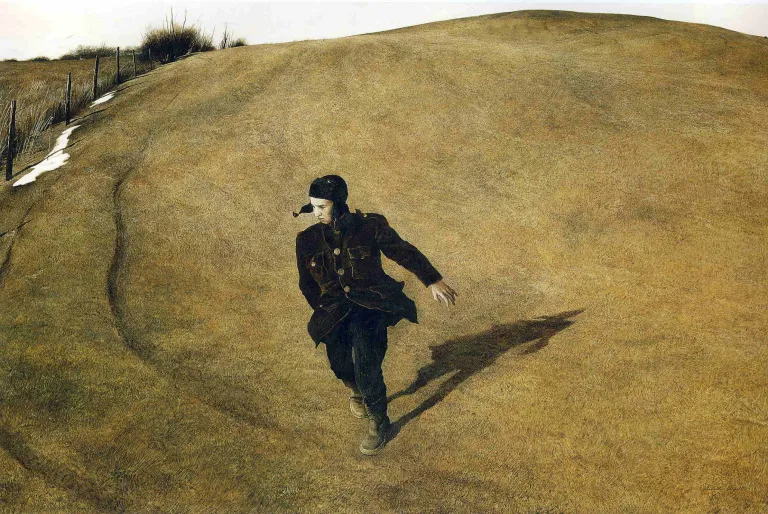
Winter 1946
I wish I could paint without me
existing—that just my hands were there.
Andrew Wyeth, Interview with Life Magazine, 1965
A wish almost granted,
as the landscape folds over
in illusion and devours us whole.
Imagine, for a moment, the other swarms of the dead, each pieces
of their former selves. Torsos and ears and the occasional tongue
unyoked from the back of a throat. These leftovers, arthritic in haunting
gyrations, hoping
they communicate something loud
enough to penetrate this Pennsylvania holler.
At other times, they stand still for their portraits, not understanding
their own incomplete image of a body.
And yet, you paint them all. In detachment. In loneliness and cold hush.
In necrotic spruce. Perennial ryegrasses. The thousand species of fescue.
Only later, you would admit that just past the hill, right outside the frame’s horizon,
is the intersection between your father’s life and the oncoming train.
You admitted that—after his death—
you were sick with regret
you had never painted him.
So here you have made your attempt:
Here is the fence line. There a snow drift. The boy’s hand, groping air behind him,
where his shadow is embedded—almost upright, disembodied and chasing—in the gangrene
earth.
And the hill, this rising stretch where you chose to leave
your hands to float. Incorporeal, without formula, but finally feeling
the sticky tempera caked into your knuckles
and the human presence in this sweep of earth.
There, he is found. The land that consumed him keeps the meaning
of him. Your father, suffused
by light and dissolving
with each futile change of the season.
Jon Savage is a writer and visual artist, currently based in Maryland. He earned his MFA from New York University in 2016, and his writing has been featured in Monkey Bicycle and Flapperhouse. He spends most of his time painting and working on a novel he’s not sure he’ll ever finish. His work can be found at https://www.savagejon.com/